MS in Data Science
GRADUATE
MS in Data Science

APPLICATIONS
Now Open For Fall 2026
START DATE
September 2026
APPLICATION DEADLINE
Rolling Admissions
FEES
No Application Fee
$10,000 All-In MS in Data Science
Tuition is $10,000 for 36 credits
Early Action Award
Apply. Become accepted.
Deposit by August 21, 2026, and
receive a 5% Early Action Scholarship off of your tuition.
Complete Your Degree in 15 months
Earn your degree fully online with a global faculty of industry experts — no GRE and no application fee required.
Meet with us!
Schedule an enrollment advising appointment with one of our counselors: https://globalcampus.aug.edu/admission-and-scholarships/admission-events-and-information-sessions/
An AI-Native Master’s for the Next Generation of Data Scientists
Build practical skills in machine learning, data engineering, analytics, generative AI, and agentic workflows—fully online, in as little as 15 months.
Lead with the market shift: data science is no longer just about models and dashboards. Employers increasingly expect professionals who can work with AI tools, deploy workflows, communicate insights, and solve real business problems.
Study entirely online, on your own schedule and finish in 15 months at a total tuition of just $10,000. Feel empowered to switch into or level up in one of the most in-demand careers and avoid being overwhelmed by jargon—start with strong foundations and build confidence.
Our Master in Data Science program is more than just a series of courses—it’s a journey. A journey that will take you from understanding the basics of data science to mastering advanced techniques and leading data-driven projects. Whether you’re looking to start a new career, advance in your current role, or simply stay ahead of the curve, this program will equip you with the skills you need to succeed in the data-driven world of tomorrow.
Duration: 15 months
Number of Courses: 12 courses (36 US credits)
Course Delivery: 100% online
Tuition: $10,000
Admission points: New students are admitted at the start of the fall, winter and spring terms

Apply Now | Request More Information


The Master of Science in Data Science at AUG Global Campus is a 12-course program designed to provide a comprehensive and flexible learning experience. Our curriculum is structured to help students build strong foundational knowledge, develop advanced data science skills, and gain specialized expertise in cutting-edge domains like Deep Learning, Generative AI, and Time Series Forecasting.
Program Structure
The MS in Data Science program follows a well-structured sequence to ensure students progressively build their knowledge and expertise. The program includes core courses, elective specializations, and a capstone project to provide a well-rounded and hands-on learning experience.
Core Courses (8 Required Courses)
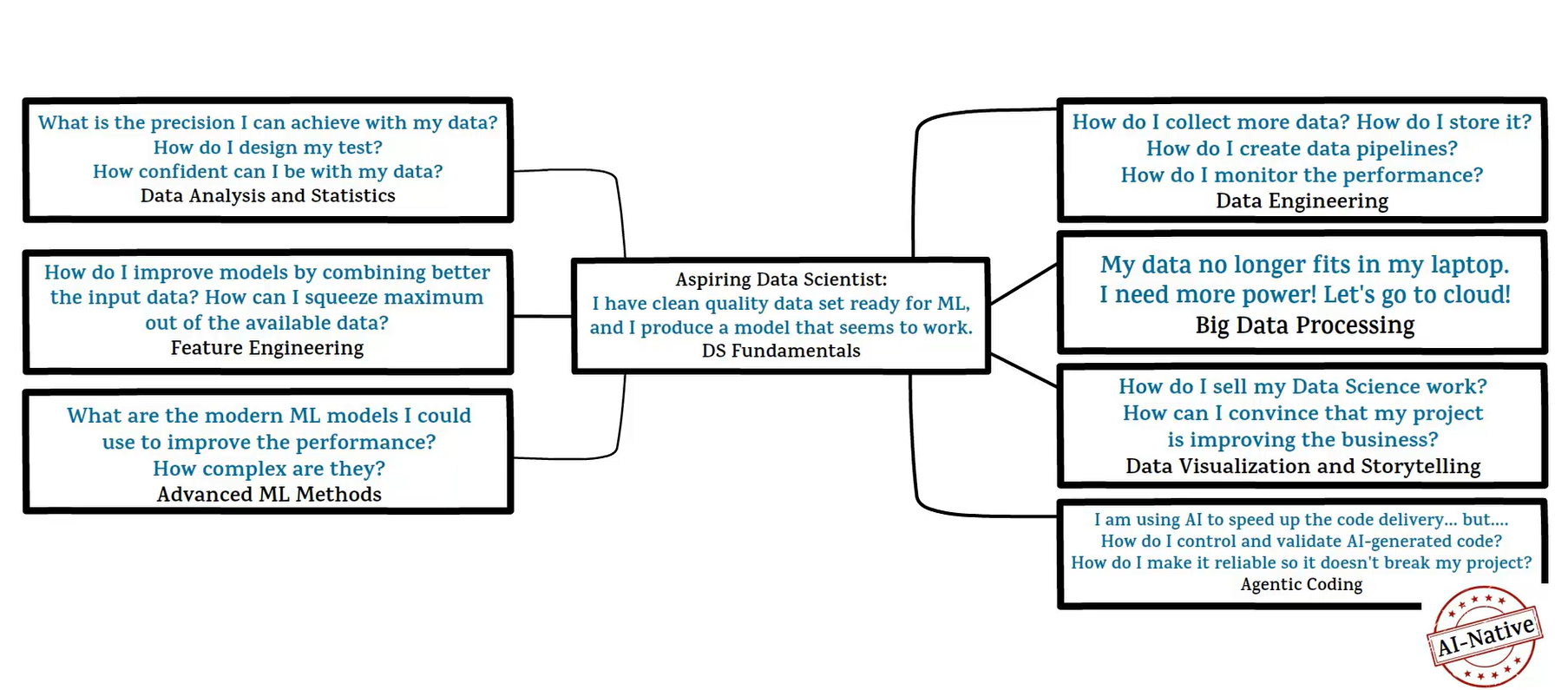
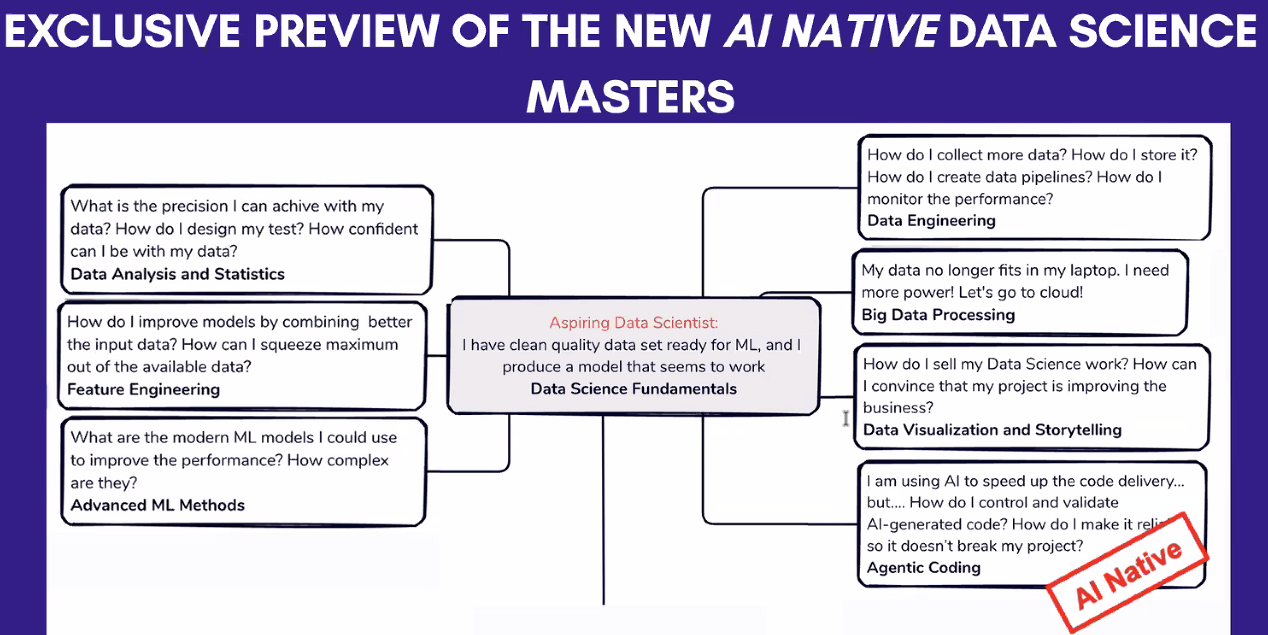
All students begin their journey with Data Science Fundamentals which is offered three times a year, allowing potential students to join the program at multiple entry points. In DS Fundamentals, we teach how to clean and transform datasets, build standard machine learning models, and evaluate their performance. By the end of this course, all students could be considered an Amateur Data Scientist— they will have an idea of what’s going on and are ready to tackle more advanced challenges in core and specialized courses.
The rest of the core courses ensure a comprehensive understanding of key data science principles. They are designed to create professional Data Scientist expanding on top of Amateur one that is formed in Data Science Fundamentals course. These courses include:
- Data Engineering: Learn how to collect, store, and manage data, as well as monitor model performance in production.
- Big Data Processing: Handle large datasets that no longer fit on your laptop.
- Data Analysis and Statistics: Gain the skills to design experiments, analyze data, and measure the precision of your models.
- Feature Engineering: Discover how to improve model performance by optimizing input data.
- Advanced ML Methods: Dive deep into advanced machine learning techniques to solve complex problems.
- Data Visualization and Storytelling: Learn how to present your findings in a compelling way that drives business decisions.
- Project Management in Data Science: Understand the bigger picture, manage stakeholders, and lead data science projects in large organizations.
Specialization Electives (3 courses are required)
Students have the flexibility to customize their learning experience by selecting three specialization courses:
- Deep Learning: Explore the cutting-edge techniques behind neural networks and deep learning models.
- Time Series Forecasting: Master the techniques for analyzing and forecasting time-dependent data.
- Information Retrieval and Recommender Systems: Learn how to build systems that predict user preferences and recommend products or content.
- Natural Language Processing (NLP): Dive into the world of text analysis, sentiment analysis, and language modeling.
- Generative AI Applications: Discover how to use GenAI models that generate new content, from images to text, in your applications.
- Business ML Applications: Apply machine learning to solve real-world business problems, from customer lifetime value, choice analytics to fraud detection.
Capstone Project
The program culminates with a capstone project, where students apply their knowledge to a real-world data science challenge. This project will be:
Industry-focused, solving real business problems with advanced data science techniques.
Portfolio-enhancing, allowing students to showcase their projects on GitHub to boost employability.
Mentored by experts, ensuring students receive feedback and industry insights throughout the process.
In the first (starting) term a student can take up to 3 courses including the pre-requisite of DS Fundamentals. In every term 2 courses with no dependency on DS Fundamentals are offered. In total (full time mode) students can take up to 4 courses per term.
From the very beginning, students are encouraged to build a portfolio of end-to-end data science solutions. They are guided to publish these projects on their GitHub accounts, showcasing their skills and expertise to potential employers.
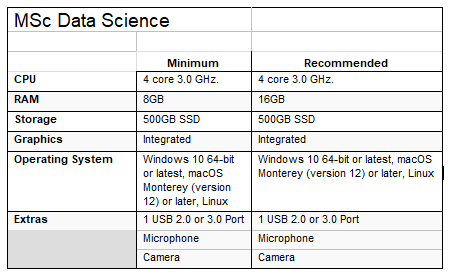
Technology Requirements:
Apply Now | Request More Information
Develop Future-Ready Data Science Expertise
The Master of Science in Data Science at AUG Global Campus equips students with the technical, analytical, and strategic skills required to excel in today’s data-driven world. Our program-level competencies ensure that graduates are proficient in key areas such as machine learning, artificial intelligence, data engineering, and business intelligence. Whether you are aspiring to be a Data Scientist, AI Specialist, or Business Intelligence Analyst, our program prepares you to lead with confidence.
- AI-native curriculum
- Portfolio-building capstone
- Global faculty with industry experience
- Online flexibility with practical tools
From the very beginning, students are encouraged to build a portfolio of end-to-end data science solutions. They are guided to publish these projects on their GitHub accounts, showcasing their skills and expertise to potential employers.
The Master in Data Science program emphasizes hands-on lab experience throughout the entire curriculum. From the early phases of the program, Data Science foundational course introduces transversal components such as setting up and managing Python environments, programming with Notebooks, version control with GitHub, creating pipelines with Kedro etc. As students progress, they engage with real datasets, learning to clean and prepare data, and build machine learning models in a lab-like environment. The program includes practical exercises and projects that utilize various Python libraries, including NumPy, Pandas, Matplotlib, Seaborn, and Scikit-Learn.
In addition to these, students gain experience with data engineering tools such as Airflow, MySQL, MongoDB, REST APIs, and BeautifulSoup, always maintaining a hands-on approach. The integration of Amazon Web Services (AWS) into the program provides students with practical experience in cloud platforms and cluster management. Throughout the program, students will collaborate in teams on GitHub projects, simulating real-world work environments and enhancing their teamwork and project management skills. This collaborative approach helps students understand the dynamics of working in professional data science teams.
Core Competencies
1. Data Science Fundamentals & Analytical Thinking
- Develop a strong foundation in statistics, probability, and linear algebra to understand and apply data science concepts effectively.
- Gain expertise in exploratory data analysis (EDA) to derive insights from structured and unstructured data.
- Learn how to evaluate and interpret data-driven results to make informed business decisions.
2. Programming for Data Science
- Master Python, an industry-standard programming language for data manipulation, analysis, and visualization.
- Work with key data science libraries such as NumPy, Pandas, Matplotlib, Seaborn, Streamlit, Scikit-Learn, BeautifulSoup and Git.
- Understand best practices for writing efficient and scalable code for data science projects.
3. Machine Learning & AI Implementation
- Design and implement supervised and unsupervised learning algorithms, including regression, classification, clustering, and deep learning.
- Utilize state-of-the-art AI models and frameworks such as TensorFlow and PyTorch.
- Apply model evaluation metrics (accuracy, precision, recall, F1 score) to assess and optimize model performance.
4. Big Data & Cloud Computing
- Work with large-scale datasets using big data technologies such as Apache Spark, Hadoop, and SQL-based systems.
- Implement cloud-based solutions using AWS, Google Cloud, or Microsoft Azure for scalable data storage and processing.
- Learn distributed computing techniques to handle real-world, large-scale data challenges.
5. Data Engineering & Data Preparation
- Gain expertise in data preprocessing, cleaning, and transformation to ensure high-quality data inputs.
- Learn to use ETL (Extract, Transform, Load) processes for handling structured and unstructured data.
- Work with relational and non-relational databases such as MySQL, PostgreSQL, or MongoDB.
6. Business Intelligence & Data-Driven Decision Making
- Develop skills in data visualization using tools like Matplotlib, Seaborn, Plotly, and Streamlit.
- Learn to communicate data-driven insights to stakeholders through compelling storytelling.
- Apply data science to solve real-world business challenges across industries, including finance, healthcare, and e-commerce.
7. Ethics & Responsible AI
- Understand the ethical implications of data science, including bias detection, privacy concerns, and fairness in AI.
- Learn how to apply responsible AI practices to ensure transparency and accountability in machine learning models.
- Develop a strong understanding of regulatory frameworks like GDPR and CCPA.
8. Hands-On Portfolio Development & Real-World Applications
- Build a professional portfolio by working on real-world projects and case studies.
- Publish end-to-end data science solutions on GitHub to showcase your expertise to employers.
- Participate in industry-driven capstone projects that solve business-critical data problems.
Graduate Outcomes & Career Readiness
By the end of the MS in Data Science program, graduates will:
- Be proficient in designing, developing, and deploying end-to-end machine learning solutions.
- Have a competitive edge in the job market with industry-ready data science and AI skills.
- Be capable of leading data-driven decision-making processes in organizations across various sectors.
- Be prepared for roles such as Data Scientist, Data Analyst, AI Engineer, Machine Learning Engineer, Business Intelligence Analyst, (Big) Data Engineer and similar.
Join the Future of Data Science
Advance your career with The AUG Global Campus MS in Data Science and become a leader in the data revolution. Whether you are an aspiring data scientist or a professional looking to upskill, this program will provide you with the competencies needed to succeed in a world driven by data and AI.
Enroll today and shape the future with data science!
The American University of Greece Global Campus (AUGGC) is proudly accredited by the New England Commission of Higher Education (NECHE) and authorized by the Massachusetts Board of Higher Education. As an international institution from a financial aid perspective, AUGGC students are not eligible for U.S. federal financial aid. However, we are committed to making high-quality, globally recognized education accessible and affordable.
Our base tuition is highly competitive by North American standards, and we encourage students to explore a variety of funding options, including private loans, employer tuition benefits, and other financial resources.
$10,000
36 Credits at $278/credit
Complete in 15 - 24 months
Our admissions team is available to discuss payment plans and help you identify the best options for making your education at AUGGC a reality.
See here for more information: Paying for Your Education.
Tuition Calculator

Built for an AI-powered future
The MS in Data Science is designed to prepare students for the rapidly evolving world of data, machine learning, and generative AI. The updated program direction emphasizes modern data science practice, including AI, large language models, prompt engineering, and agentic workflows, helping students build skills that reflect where the field is going next.
A strong foundation through Data Science Fundamentals
Every student begins with Data Science Fundamentals, a gateway course that builds confidence in Python, Jupyter Notebooks, data preparation, visualization, machine learning, and Git-based portfolio development. This course is designed to take students from aspiring data scientist to advanced study with a shared practical foundation.
Career-relevant curriculum with applied technical depth
The program combines core study in data engineering, statistics, feature engineering, big data, advanced machine learning, data visualization, and project management with specialized study in areas such as generative AI, natural language processing, time series forecasting, and business machine learning applications. The curriculum is designed to connect technical knowledge to real-world business and industry use cases.
Flexible by design, with multiple entry points
Students can begin with Data Science Fundamentals, which is offered multiple times per year, creating more than one entry point into the program. The structure is also designed to support both full-time and part-time progression, making it possible for students to advance at a pace that fits their professional and personal commitments.
100% online, asynchronous learning
The program is delivered fully online in an asynchronous format, allowing students to learn with flexibility while following a structured weekly cycle. Each 13-week course includes curated academic content, media resources, learning activities, weekly graded quizzes, and a combination of summative and formative assessment.
Hands-on tools and platforms used in the field
Students gain practical experience with widely used tools and technologies including Python, Jupyter Notebooks, Pandas, NumPy, Matplotlib, Seaborn, Scikit-learn, TensorFlow, Keras, Plotly, Streamlit, Airflow, MySQL, MongoDB, REST APIs, AWS, and Git-based portfolio workflows. This applied approach helps students graduate with relevant, workplace-ready technical skills.
Portfolio-building capstone experience
The program culminates in a capstone project centered on a real-world data science challenge. Students are encouraged to produce work that is industry-relevant, mentored by experts, and suitable for inclusion in a professional portfolio, helping them demonstrate their capabilities to employers.
Faculty with academic and industry expertise
The program is taught by a mix of subject-matter experts from industry and academic faculty with strong teaching and research backgrounds. This blend of expertise helps keep the curriculum current, practical, and aligned with employer needs.
Designed for real career outcomes
The program is built to prepare graduates for roles such as Data Scientist, Data Engineer, Data Analyst, and related positions. Across the curriculum, students develop the technical, analytical, communication, and project skills needed to solve real-world challenges and create business value through data.
The field of data science continues to offer promising career opportunities, with competitive salaries and a robust job outlook. There's a shift towards specialized roles such as machine learning engineers, data engineers, and AI/ML engineers, moving away from generalist data scientist positions. (GSD Council) with a notable demand for the following skills:
Python is the most in-demand programming language, appearing in 78% of data scientist job postings in 2023.
Machine learning is mentioned in 69% of job listings.
The demand for natural language processing (NLP) skills has risen from 5% in 2023 to 19% in 2024. (365DataScience)
Graduates of the MS in Data Science program will have an advantage in these careers in view of the skills they will develop as a result of the MS Data Science program.
- Programming & Tool Proficiency – Master Python, Anaconda, Jupyter Notebooks, Pandas, PySpark, BeautifulSoup, Plotly, Streamlit, SQL, Tensorflow, LangChain, Git etc.
- Data Science Fundamentals – Exploratory data analysis, regression and classification techniques with corresponding model evaluation metrics and visualizations.
- Data Engineering – collect, store, and manage data, data wrangling, creation of pipelines, monitor model performance and data drift.
- Big Data – Work with large-scale datasets using PySpark, and cloud computing.
- Machine Learning & AI – Build complex ML models and work with deep learning and generative AI applications. Learn how to design experiments, evaluate adequately model performance and how to squeeze the maximum out of the available data.
- Business Intelligence & Storytelling – Present your findings in a compelling way that drives business decisions.
- Project Management – Understand the bigger picture, manage stakeholders, and lead data science projects in large organizations.
- Portfolio Development – Create end-to-end data science solutions, documented on GitHub, showcasing expertise to potential employers.
Apply Now | Request More Information
Our Master of Science in Data Science program is designed for ambitious professionals and aspiring data scientists looking to develop in-demand technical and analytical skills. Whether you are transitioning into data science or advancing in your current role, our program provides the tools to help you thrive in today’s data-driven world.
Ideal Candidates for the MS in Data Science:
1. Aspiring Data Scientists
- Individuals with a strong interest in analytics, programming, and machine learning.
- Recent graduates in STEM fields (Computer Science, Engineering, Mathematics, Statistics) looking to enter the data science job market.
- Career changers seeking a high-growth industry with lucrative job opportunities.
2. Professionals Looking to Upskill
- Software engineers, IT professionals, and analysts looking to transition into data science.
- Business analysts and financial professionals eager to apply data-driven decision-making to their work.
- Professionals seeking to integrate AI and machine learning into their industries (e.g., healthcare, marketing, supply chain, travel, etc).
3. Business Leaders & Managers
- Executives and managers who need to lead data-driven initiatives and make strategic decisions.
- Team leaders responsible for managing data science and analytics teams.
- Entrepreneurs who want to leverage data science for business growth and innovation.
Join the next generation of data scientists and transform your career with the MS in Data Science program at AUG Global Campus!
Ready to get started?
Apply Now | Request More Information
Learn from accomplished scholars and practitioners
At The American University of Greece Global Campus, students learn from faculty who bring together academic excellence, industry insight, and global perspective. Our instructors are experienced educators, researchers, and professionals who help students connect theory to practice in ways that are relevant to today’s workplace.
Dr. Antonio Almagro - Co-Director, MS in Data Science
Dr. Antonio Almagro is a data science leader specializing in machine learning, analytics, and data engineering. He holds a PhD in Fluid Mechanics from Universidad Carlos III de Madrid and engineering degrees in industrial and aerospace engineering. He currently serves as a Senior Staff Data Scientist at TomTom and has previously held senior data science roles at YouGov and Amadeus. His work combines technical depth with a strong commitment to practical, human-centered data storytelling.
Dr. Igor Arambašić - Co-Director, MS in Data Science
Dr. Igor Arambašić is a senior data science leader with a strong track record of leading high-performing, cross-cultural teams in international settings. As Co-Director of the MS in Data Science at The American University of Greece Global Campus, he helps guide a forward-looking curriculum that bridges technical expertise, applied learning, and strategic insight. His experience in data science, AI, and team leadership brings real-world relevance to the online classroom. He is committed to preparing students to thrive in a rapidly changing, data-driven global economy.
Dr. Daniel Mateos San Martín
Dr. Daniel Mateos San Martín brings an interdisciplinary background to data engineering, combining expertise in molecular biosciences, programming, machine learning, and applied data work. He holds a PhD in Molecular Biosciences and an MSc in Molecular Biology from the Autonomous University of Madrid. His professional experience spans data science consulting, higher education teaching, and technical innovation. His work reflects a strong interest in translating complex scientific and technical problems into practical, data-driven solutions.
Dr. Nektaria Tryfona
Dr. Nektaria Tryfona is a computer engineer and data science educator with more than twenty-five years of academic and industry experience. She serves as Collegiate Faculty at Virginia Tech and is the founder of the Mason DataLab initiative. Her research and teaching focus on databases, data engineering, artificial intelligence, and data-driven innovation. She has led interdisciplinary projects and professional programs that connect academia, government, and industry.
Dalibor Starčević
Dalibor Starčević brings an applied, project-focused perspective to the field of data science and operations. His professional background includes leadership in systems development, implementation, and quality management, with an emphasis on practical execution and organizational performance. This experience supports his teaching in project management by connecting analytical work to real-world delivery, coordination, and decision-making. His approach helps students understand how technical projects succeed within complex organizational environments.
Dr. Dimitrios Vogiatzis
Dr. Dimitrios Vogiatzis is an Assistant Professor whose work centers on machine learning, artificial intelligence, and data mining. He holds a PhD in Computer Science in Machine Learning from the National Technical University of Athens and an MSc in Knowledge Based Systems from the University of Edinburgh. He is affiliated with both Deree – The American College of Greece and the National Center for Scientific Research Demokritos. His teaching and research reflect a strong focus on intelligent systems and the real-world application of machine learning.
Lea Villasante Núñez
Lea Villasante Núñez is a data and analytics professional with experience applying data science in industry settings. Her work has included leadership in data and analytics as well as hands-on engagement with machine learning and applied data projects. She brings a practical perspective to the classroom, helping students connect advanced analytical methods with real business and technology use cases. Her teaching emphasizes the real-world value of thoughtful, well-structured data work.
Dr. Georgios Moulantzikos
Dr. Georgios Moulantzikos is a mathematician and educator whose interests include machine learning and deep learning applications in areas such as natural language processing, computer vision, and finance. He holds a PhD in Mathematics from the University of Sheffield and an MSc in Mathematics from the University of Crete. His academic background brings strong quantitative rigor to the study of data science. He helps students build the mathematical and analytical thinking needed for advanced modeling and forecasting.
Admission is open to individuals who demonstrate basic proficiency in relevant areas through formal education, professional experience or alternative verifiable means such as relevant courses and/or certifications. Applicants are expected to have:
- Basic Programming Skills –demonstrated through a certificate or proven proficiency during an interview. You may speak with your Admissions Counselor for more information.
At the American University of Greece Global Campus, we consider a student’s lived experience. The admissions requirements below are guidelines.
The minimum graduate admission requirements are:
1. A bachelor’s degree in any discipline from an accredited institution with an average G.P.A. of 3.0 or better.
a. Applicants who do not meet the minimum criteria may be admitted to the program on conditional status if the institution perceives other strengths in their application (e.g., strong research or relevant work experience, or other outstanding achievements during the applicants’ undergraduate experience).
2. Motivation to undertake graduate-level study and work to also be determined by:
a. Two recommender’s contact information
b. A personal statement of approx. 500 words submitted with the application form
c. An interview is optional and under the discretion of the Admissions Committee
3. English Proficiency Requirement for Admission
The American University of Greece (AUG) Global Campus delivers all programs in English. To ensure student success in an online learning environment, applicants whose primary language is not English must demonstrate English proficiency through one of the following pathways:
1. Standardized English Language Tests
Applicants may submit official test scores meeting or exceeding the following minimum requirements:
- TOEFL iBT: 87
- IELTS Academic: 6.5
- Duolingo English Test: 125
- PTE Academic: 59
- Cambridge/Michigan/MSU English: Proficiency
Official test scores must be no more than two years old.
2. Previous Education in English
Applicants may be exempt from submitting test scores if they have completed:
- A bachelor’s degree (or equivalent) from an accredited institution where English was the primary language of instruction.
- At least two years of full-time secondary or postsecondary education in an English-speaking country or an institution where English is the primary language of instruction.
Applicants must provide official transcripts and, if necessary, documentation from the institution confirming English as the language of instruction.
3. Workplace Experience in an English-Speaking Environment
Applicants who have worked in an English-speaking professional setting for three or more years may submit:
- A letter from their employer verifying their role and confirming English proficiency in professional communication.
- A resume highlighting English-language experience in professional settings.
- A personal statement describing how they have used English in their work and daily interactions.
Additional Considerations:
- AUG Global Campus reserves the right to request an interview to further assess English proficiency.
- Applicants who have completed international curricula such as the International Baccalaureate (IB) or British A-Levels in English may also qualify for an exemption.
- For applicants who do not meet the minimum scores but are close, a case-by-case review may be conducted, particularly for those with strong academic backgrounds.
4. Identification in the form of: Birth Certificate or Passport (to determine scholarship level where applicable)
5. Completed online application
Note: American University of Greece Global Campus is not eligible for the United States of America Federal Aid.
Credit Transfer
Credit transfer from previously attended graduate degree programs of accredited institutions may be allowed at a maximum limit of 9 credits and will be examined on an individual basis.
- Credit may be given for courses taken in the graduate program of an accredited institution.
- The Program Coordinator, in consultation with the respective instructor, approves (or otherwise) the transfer on the basis of sufficient equivalence – in content, learning outcomes, and number of credits;
- The cumulative index (CI) of the prospective transfer course must be at least 3.00 (or its equivalent);
- No grades are assigned to courses accepted for transfer and those courses do not affect the student’s cumulative index (CI) at the College.
Note: American University of Greece Global Campus is not eligible for the United States of America Federal Aid.